Blog > How Much Cash Do You Need to Buy a Home? A Market-by-Market Guide
The short answer: It depends on three things: the price, your loan and where the home is.
Most buyers plan for the first two. The third is easy to miss. On the same $400,000 home, the buyer's share of transfer tax alone ranges from $0 in Greater Cleveland to $10,000 in the City of Pittsburgh.
This guide explains what goes into your cash to close and how it changes across Philadelphia, its suburbs, Pittsburgh, New Castle County in Delaware, Cecil County in Maryland and Greater Cleveland.

What Goes Into Your Cash to Close?
Cash to close is the amount you bring to settlement. It has four parts:
- Down payment: your share of the purchase price.
- Closing costs: lender charges, title and settlement fees, and government fees and taxes.
- Prepaids and escrow: money set aside up front for property taxes, homeowners insurance and interest.
- Minus credits: earnest money you already paid, plus any seller or lender credits.
Your lender gives you a Loan Estimate after you apply. Your final number appears on the Closing Disclosure, which you must receive at least three business days before closing.
Lender and title charges vary by lender, loan and property, so comparing Loan Estimates is worthwhile. Transfer taxes are different. Government sets them, they follow the property's location, and you can estimate them before you make an offer.
How Much Do You Need for a Down Payment?
Minimums depend on the loan:
- Conventional: as little as 3% for eligible buyers.
- FHA: 3.5% with a credit score of 580 or higher.
- VA: often no down payment for eligible service members, veterans and some surviving spouses. Most VA borrowers pay a one-time funding fee, which can be added to the loan.
On a $400,000 home, 3% is $12,000 and 3.5% is $14,000. These are floors, not targets. Your lender confirms what you qualify for.
What About Earnest Money?
Earnest money is a deposit you make after your offer is accepted. A neutral third party usually holds it.
At closing, it's credited toward your purchase, so it reduces what you bring that day. It is not an extra cost.
You can lose it if you back out for a reason your contract doesn't allow. The amount is negotiated, so ask your agent what's common for your market and price point.
Where You Buy Changes the Math
Transfer tax is charged when a home changes hands. It's where CCL's markets differ most.
Three numbers matter:
- The total rate: what government collects.
- The buyer's share: what you typically pay.
- The seller's share: what the seller typically pays.
The total rate is not your cost. In most of these markets, the tax is split between buyer and seller by custom or by state law. In Cuyahoga County, Ohio law puts it on the seller. In nearly every market, your contract can change the split.
Transfer Tax on a $400,000 Purchase
This comparison shows transfer tax only, not total cash to close. It assumes a standard purchase (not a first-time buyer) and a typical contract.
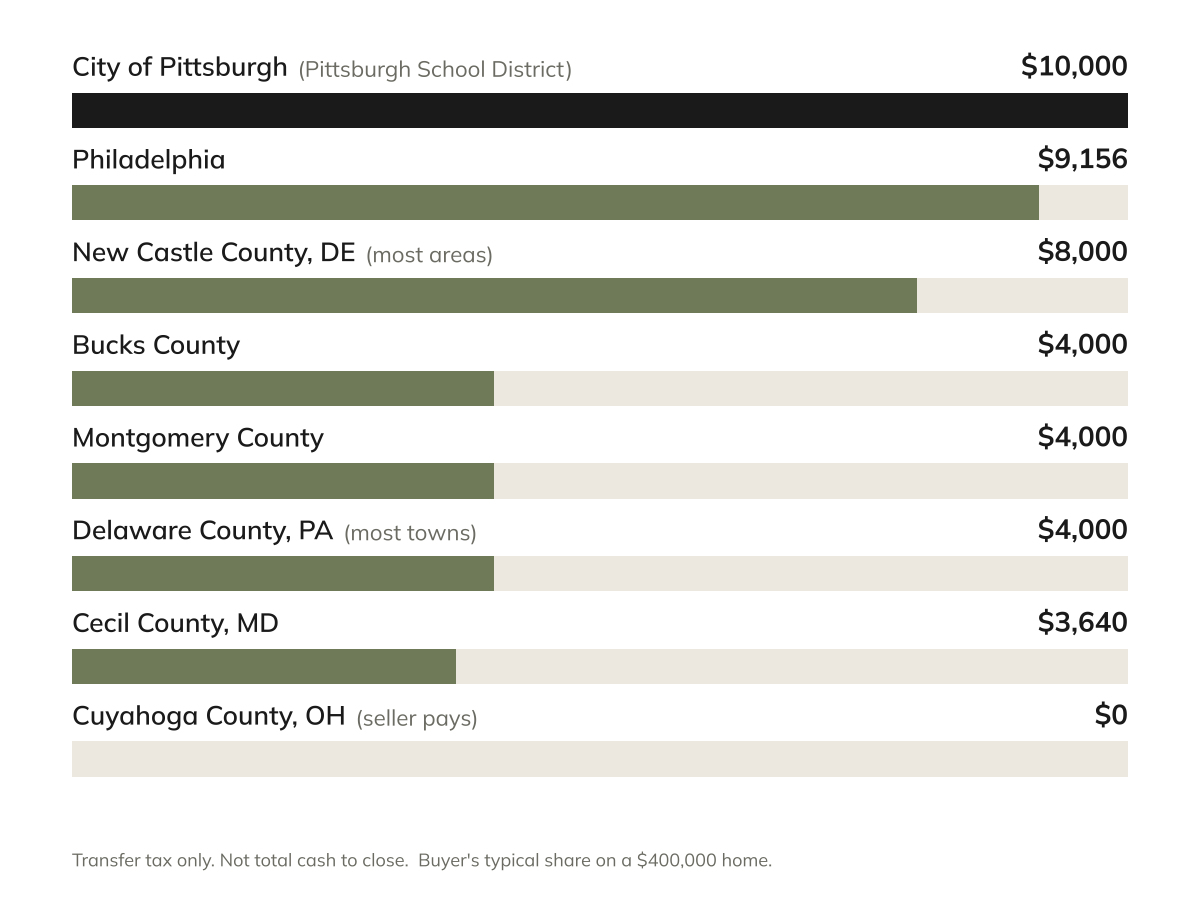
Rates can differ by town and school district within a county. First-time buyers in Delaware and Maryland pay less. Both are covered below.
What to Know in Each Market
Philadelphia
The 4.578% rate is 3.578% to the City plus 1% to the state. The even split is custom, not law, and the City can collect the full tax from either party. Buyers should confirm it's paid in full at closing.
Relocating? See our guide to Moving to Philadelphia.
Bucks, Montgomery and Delaware Counties
Most of the Philadelphia suburbs sit at 2%. A few Delaware County towns are higher:
-
2.5% total: Radnor, Upper Darby and Chester City. The buyer's typical share on $400,000 is $5,000.
-
3% total: Upper Providence. The buyer's typical share on $400,000 is $6,000.
Pittsburgh and Allegheny County
The 5% rate applies to City of Pittsburgh homes in the Pittsburgh School District. City homes in the Baldwin-Whitehall School District are at 4.5%. Across the rest of Allegheny County, totals range from 2% to 3%, depending on the municipality.
Confirm the exact municipality and school district before you estimate. In this county, they move the number most.
New Castle County, Delaware
Most of the county is at 4%: 2.5% to the state and 1.5% to the county or town. Arden, Ardentown and Ardencroft have no local transfer tax and pay 3%.
Delaware law splits the tax equally between buyer and seller. Your contract can change that, so read the transfer tax terms in your agreement of sale.
Cecil County, Maryland
The 1.82% combines three charges:
-
a 0.5% state transfer tax
-
a 0.5% county transfer fee
-
a recordation tax of $4.10 per $500 of the price
Maryland law presumes buyer and seller share them equally unless the contract says otherwise.
Greater Cleveland
In Cuyahoga County, transfer tax usually isn't a buyer cost. The cost to watch is city inspections.
Several suburbs inspect homes before a sale. If violations remain at transfer, money may have to be held in escrow until repairs are done:
-
Cleveland Heights: 125% of the estimated repair cost, for major violations.
-
Shaker Heights: 150% of the estimated repair cost, with a process to request a reduction to 100%.
If you plan to take on repairs the city has flagged, ask early who will fund that escrow. It can change your cash to close.
First-Time Buyers in Delaware and Maryland
Both states reduce transfer taxes for first-time buyers, but they define "first-time buyer" differently.
Delaware
- Who qualifies: buyers who have never owned residential real estate anywhere and will live in the home.
- What changes: your share of the state transfer tax drops by up to $2,000, claimed at closing. The seller's share doesn't change.
- Example: on a $400,000 home in most of New Castle County, an eligible buyer's share falls from $8,000 to $6,000.
Maryland
- Who qualifies: buyers who have never owned a Maryland home that was their principal residence, and who will live in this one. Owning a home in another state doesn't disqualify you.
- What changes: the state transfer tax drops to 0.25%, and the seller pays all of it. Cecil County's transfer fee is waived. The seller pays the recordation tax by default.
- Bottom line: an eligible buyer in Cecil County owes $0 of these taxes by default. The contract can assign the recordation tax differently if both sides expressly agree.
Can the Seller Help With Closing Costs?
Yes. Seller credits are negotiated in your contract and can lower the cash you need at closing.
Every loan program limits how much a seller can contribute, and credits generally can't be used toward your down payment. Your lender will confirm the limit for your loan.
How to Estimate Your Number
- Get a Loan Estimate for your loan program.
- Confirm the home's exact municipality and school district.
- Check how your contract splits transfer taxes, and whether first-time buyer rules apply in Delaware or Maryland.
- Review your Closing Disclosure when it arrives. That's your final number.
Frequently Asked Questions
Q: How much cash do I need to buy a $400,000 home?
A: It depends on your loan and location. The minimum down payment is $12,000 at 3% on an eligible conventional loan, or $14,000 at 3.5% with FHA. Then add closing costs and prepaids, and subtract any credits. Your share of transfer tax alone ranges from $0 in Cuyahoga County to $10,000 in the City of Pittsburgh.
Q: Who pays transfer tax in Pennsylvania?
A: State and local governments don't set who pays. Most contracts split it evenly. Buyer and seller are both legally responsible for the state's 1%, and Philadelphia can collect its full tax from either party.
Q: Do first-time buyers pay less transfer tax?
A: In Delaware and Maryland, yes. Eligible Delaware buyers save up to $2,000 on their share. Eligible Maryland buyers in Cecil County owe none of these taxes by default.
Q: Is earnest money part of my down payment?
A: It's credited toward your purchase at closing. It reduces what you bring that day rather than adding to it.
Talk Through the Numbers Before You Offer
The same price can mean very different closing math depending on the town, the school district and the contract.
If you're considering a home in Philadelphia, the surrounding counties, Pittsburgh, New Castle County, Cecil County or Greater Cleveland, CCL can help you understand the local costs before you make an offer.
Send us the address or the area you’re considering and your target price. We’ll go over the transfer taxes and local costs that apply, so you know what to plan for before you write an offer.
Talk to CCL About Your Numbers
Call: (215) 360-3236
Email: concierge@cclre.com
This guide is general information, not legal, tax or lending advice. Tax rates and program rules can change. Confirm current figures with your lender, settlement company or attorney before you buy.